

Saturday, May 11, 2019
Shelf Awareness--Our Castle by the Sea

Wednesday, May 8, 2019
May's Book of the Month--A Heart in a Body in the World

When Annabelle Agnelli gets hit on by some guys at a local fast food restaurant, she snaps. Ditches everything and starts running. Annabelle has been trying to deal with tragic events from a year ago that left her emotionally broken, and changed her world forever. Now, suddenly, she decides that she needs to run across the country, from Seattle to Washington, DC, because doing “something is better than nothing." Helped by the organizational skills of her younger brother Malcolm, and a support team of close friends who set up a GoFundMe account and business plan to publicize her half marathon-a-day endeavor, and accompanied by her Grandpa, AKA Capitano/Captain Ed, in his RV, Annabelle begins to run her way through the heart of America, as well as through the guilt and shame imposed on her by The Taker. Along the way, she begins to process what happened, and maybe even to heal.
This is not a novel comprised of only dark moments, however heavy the main storyline is. The author paints a vivid picture of Annabelle’s life with on the road with Grandpa Ed, including his snoring and excessive use of cologne whenever Dawn Celeste is nearby. Also, the emotional ups and downs of a having a doting but anxiety-riddled mother Gina, the absence of her dad That Bastard Father Anthony, her relationship with beloved “butthead” brother Malcolm, and the unfurling of her tentative affection for a “Portland-Seattle hippie cliché” boy with “a mess of curls," all make this novel as endearing as it is important.
Like the lone wolf tree, Annabelle has been “damaged bad,” she’s been “gnarled and broken,” but she’s a survivor.
--Lynn
Friday, April 19, 2019
Shelf Awareness--The Quiet Crocodile Goes to the Beach
 PB Review: The Quiet Crocodile Goes to the Beach
Tuesday, April 16, 2019
April Recommendations

A CURSE SO DARK AND LONELY, by Brigid Kemmerer, is my favorite novel of the year, so far. It’s an inspired retelling of Beauty and the Beast, with Prince Rhen under a nasty curse that dooms him to repeat his eighteenth year over and over, until he finds a woman who can love him--even though he turns into a monster and kills any living thing in his path. Harper is the 327th such woman, brought over from “real world” Washington, DC, for Rhen’s last chance to save his kingdom. Harper is tough enough to change things up, and might just be the one, but that Enchantress and her curse are so strong… (YA)

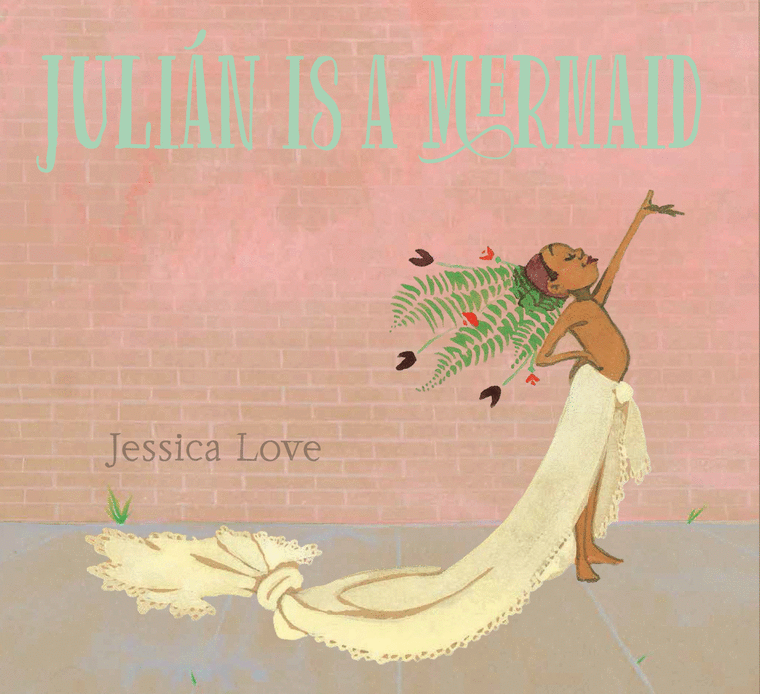
I finally got a look at JULIÁN IS A MERMAID, by Jessica Love. Inspired by a book he’s reading--and three women on the subway--Julian decides he’s a mermaid. He uses his abuela’s flowers and window curtain to dress up and, rather than getting angry, she donates a strand of beads, then takes him join the rest of the mermaids in a parade. The watercolor, gouache, and ink illustrations are gorgeous and, aside from the uplifting themes, it’s a terrific look at how an artist can incorporate fantasy elements into an otherwise realistic setting.


--Lynn
Saturday, April 6, 2019
Shelf Awareness--Sweet Dreamers

Tuesday, April 2, 2019
April's Book of the Month--Hello Lighthouse

This lighthouse “is built to last forever,” and even though changes happen as the years go by, the lighthouse remains steadfast, always “sending its light out to sea,/guiding ships on their way.”
Repeating circular motifs in the art reinforce the circular nature of the text. We begin “on the highest rock of a tiny island/at the edge of the world,” where a new keeper arrives to polish the lens, trim the wick, wind the clockwork, and do all tasks necessary to tend the light. HIs wife arrives, and then a baby. Storms come and go. By story's end, we are still on that “highest rock of a tiny island/at the edge of the world,” even though the keeper and his family now gaze at the light from a house on the mainland. The keeper has been replaced by a machine, but readers understand that all is well, and surely all will continue to be well, with the lighthouse on the job. Which is actually an interesting twist—it’s the lighthouse that’s the main character, and although the keeper, his wife, their daughter, and occasional visitors add a touch of humanity to the picture, they are only passersby. HELLO LIGHTHOUSE is a tribute to the lighthouse.
Blackall has found so many ways to depict water in this book! Chinese ink and watercolor illustrations are delicate, yet vibrant, with jewel-toned colors. Many pages have circular insets, which offer multiple scenes and perspectives on their spreads. The text is rhythmic and repetitive, feeling quite a bit like the ebb and flow of the sea. The book itself is tall to accommodate the vertical shape of its title character.
--Lynn
Monday, March 18, 2019
Shelf Awareness--Gondra's Treasure
PB Review: Gondra's Treasure
 Gondra's Treasure by Linda Sue Park, illus. by Jennifer Black Reinhardt (Clarion, 40p., ages 4-8, 9780544546691, April 2, 2019)
Gondra is a dragon. Her "mom's family comes from the West" and her "dad's family is from the East"; Gondra "was born somewhere in the middle." In Linda Sue Park and Jennifer Black Reinhardt's second collaboration (Yaks Yak), young Gondra playfully explores the benefits of inheriting two very different cultural backgrounds.
This charming narrative unfolds in bantering dialogue among the three family members. Gondra's mother explains that "in the West, dragons breathe fire," while Dad says that "in the East, dragons breathe mist." When Gondra shares a baby photo of herself, she points to "a teeny tiny flame... coming from one nostril and a wisp of mist from the other." Young readers will understand perfectly that lucky Gondra reaps the benefits of both branches of her heritage--in particular, "mist is great for hide-and-seek" and fire comes in handy at a barbecue. The affection between Gondra's parents is always obvious as they cheerfully tease each other about their attributes: Dad thinks fire is dangerous; Mom thinks mist is "pretty boring" ("compared to fire," that is). Certainly, both adults agree that Gondra was "adorable... the most beautiful baby ever."
Gondra goes on to explain other ways her Eastern and Western roots merge. Both of her parents can fly, but "Mom has wings," while "Dad uses magic." If Gondra's wings grow and she inherits flying magic too, she'll "be the fastest in the family!" As for scales, Dad's are "mostly blue and green" and Mom's "side of the family has bronze scales." Gondra herself is "mostly bronze," but the end of her tail is starting to turn the bluish green of her "dear old dad." When Gondra starts talking historical habitat, readers learn that "Mom's ancestors lived in caves full of treasure," while Dad's "family lived in lakes or rivers," their only treasure "a magic pearl that [they] could hold in one claw."
Reinhardt inventively illustrates the various points of Gondra's narrative, perfectly expressing the enthusiasm and awkwardness of the not-quite-grown protagonist. The colorful ink and watercolors depict a cozy, if slightly zany, household, where mist causes rain to fall in the living room if Dad gets too excited. The character design may be somewhat silly but the dignity and grace of Gondra's dragon family is undeniable and, though they have their differences, the love they share is evident at every turn. An interesting author's note provides some historical information on dragons, but the focus of the story is clearly on Gondra's ancestry, and how she is the beautiful product of her mixed heritage. Her loving parents don't need caves full of treasure or a "magic pearl to control the weather" because "times change," and Gondra is "the best treasure ever." --Lynn Becker, blogger and host of Book Talk, a monthly online discussion of children's books for SCBWI.
Shelf Talker: Gondra, daughter of an Eastern dragon and a Western dragon, muses about the attributes of her mixed heritage that make her unusual.

Subscribe to:
Posts (Atom)