Thursday, November 17, 2022

Shelf Awareness--Interviews with Tim Collins and John Bigwood

Tim Collins: The Lure of Mystery, Puns and Puzzles


Tim Collins is the author of more than 30 books including Cosmic Colin, the Wimpy Vampire series and the Dorkius Maximus series. They have been translated into over 30 languages. He lives near Oxford. Buster Books will publish Sherlock Bones and the Case of the Crown Jewels on February 7, 2023. Shelf Awareness spoke with Collins about using classic mysteries--and puzzles--to draw kids into reading.

Are you a big Sherlock Holmes fan?

Yes, I love the Holmes canon and many of the books that have been inspired by it. I used to walk home down Baker Street every day, and pass 221B. The relationship between Holmes and Watson is one you can write to endlessly, even if you make them a dog and a cat.

What did the process for writing this book look like? Did you read any Holmes stories for inspiration before you began?

As with all detective fiction, you start with a solution and work out how to seed the mystery in the minds of readers. I wanted to pitch the book at the right level for the age group and, weirdly, many young readers guessed who did it before many adults!

I didn't re-read any specific Conan Doyle adventures before writing the book, though I found myself throwing in references to stories such as "The Adventure of the Dancing Men" and The Hound of the Baskervilles. Later in the series, there are references to the works of other crime writers, such as Agatha Christie and Ethel Lina White.

Where did you get the idea for including puzzles, mazes and other interactive challenges in this book?

The book was originally going to be a branching story in the tradition of Choose Your Own Adventure. But as Buster Books have a lot of experience with puzzle books, we decided to integrate puzzles into the story instead. At one point, we even thought of doing a branching story and puzzles at the same time, but that would have been a bit much.

How did you work with illustrator John Bigwood? Did you provide detailed notes or more general ones about the kind of puzzles you wanted?

I provided a brief description of each puzzle, and the editor, Frances [Evans], found examples of similar ones so John could see the sort of thing we were after.

The dog and cat puns are hilarious. Can you give readers an idea of how you come up with them?

I try not to come up with too many puns, because they're not great for foreign editions of the book. It's much easier to pun in English than many other languages, so you don't want to give translators too many headaches. But sometimes you just can't stop yourself. There's no way I could resist changing "Baker Street" to "Barker Street," for example.

What do you enjoy most about writing for this age group?

Books can be magical objects for this age group. They can feel a real sense of achievement when they've finished a novel on their own, especially one like this, where the puzzle-solving makes them feel part of the adventure. Many children like to collect a series and place the books in order on their shelves--a habit that never leaves some of us.

As an author, you're trying to draw children into reading for pleasure which can have a hugely positive impact on their lives.

What do you hope readers will take away from your story?

I hope the puzzle format will appeal to children who want to read but are put off by big chunks of unbroken text. And that they'll have fun trying to crack the case. Someone got in touch and said their daughter was jotting down clues in her notebook as she read it, which is excellent sleuthing!

I also hope that those who enjoy the series will one day seek out the work of Arthur Conan Doyle.

Is there anything else you'd like people to know about Sherlock Bones and Dr. Catson?

Those who are familiar with the original stories will not be surprised to discover that Bones has an arch-nemesis. He's called Moriratty, and he will cause plenty of trouble as the series goes on.


John Bigwood: Cluing in on the Art


John Bigwood is an illustrator and graphic designer based in London. He has worked across a range of books for children and adults, including How to Draw People for the Artistically Anxious and the Sherlock Bones series. Shelf Awareness spoke with Bigwood about creating the art for Sherlock Bones and his own love of puzzles.

How do you make your art?

I use a mixture of traditional and digital methods. I start the process with rough pencil sketches and, once I'm happy with the general look and composition, I begin to add more detail and character. This leaves me with a reasonably developed draft, which is then scanned into Photoshop, where I digitally create the final line work using a Wacom tablet and pen. I find placing a piece of paper over the Wacom tablet, so that I'm drawing directly on to the paper, helps to create a more organic line with the pen. The shading and textures are then added digitally, using a variety of brushes I create in Photoshop.

Producing the final artwork digitally helps me to work a lot faster and allows for any mistakes to be quickly amended, which is always helpful! I do find the initial process of drawing and sketching on paper very important, as it allows me to create the artwork more intuitively and with greater freedom. It's also nice to be able to work and draw somewhere away from my desk every now and then.

Are you a big puzzle fan yourself?

I am. I'm not sure how good I am at them, but I certainly enjoy the challenge of trying to work them out. Riddles and logic puzzles are perhaps my favorite. When I was younger, I received a book of riddles and logic puzzles for Christmas, which I absolutely loved. I spent the next two days reading aloud puzzles to my family, assuming they were enjoying them just as much as I was. Mysteriously, the book disappeared without trace just after Boxing Day, a puzzle I'm still trying to solve!

Is there anything in the art that readers should look for that might not be in the text?

I wouldn't want to give too much away, but there are a few subtle clues in some of the illustrations that might help eagle-eyed readers work out some of the story's mysteries. Being a good detective is all about spotting clues and being able to decipher what they might mean. If you look hard enough, you may well spot the odd pointer that could help you solve the case, even before Bones and Catson.

Wednesday, November 16, 2022

Shelf Awareness--Sherlock Bones and the Case of the Crown Jewels

CB Review: Sherlock Bones and the Case of the Crown Jewels


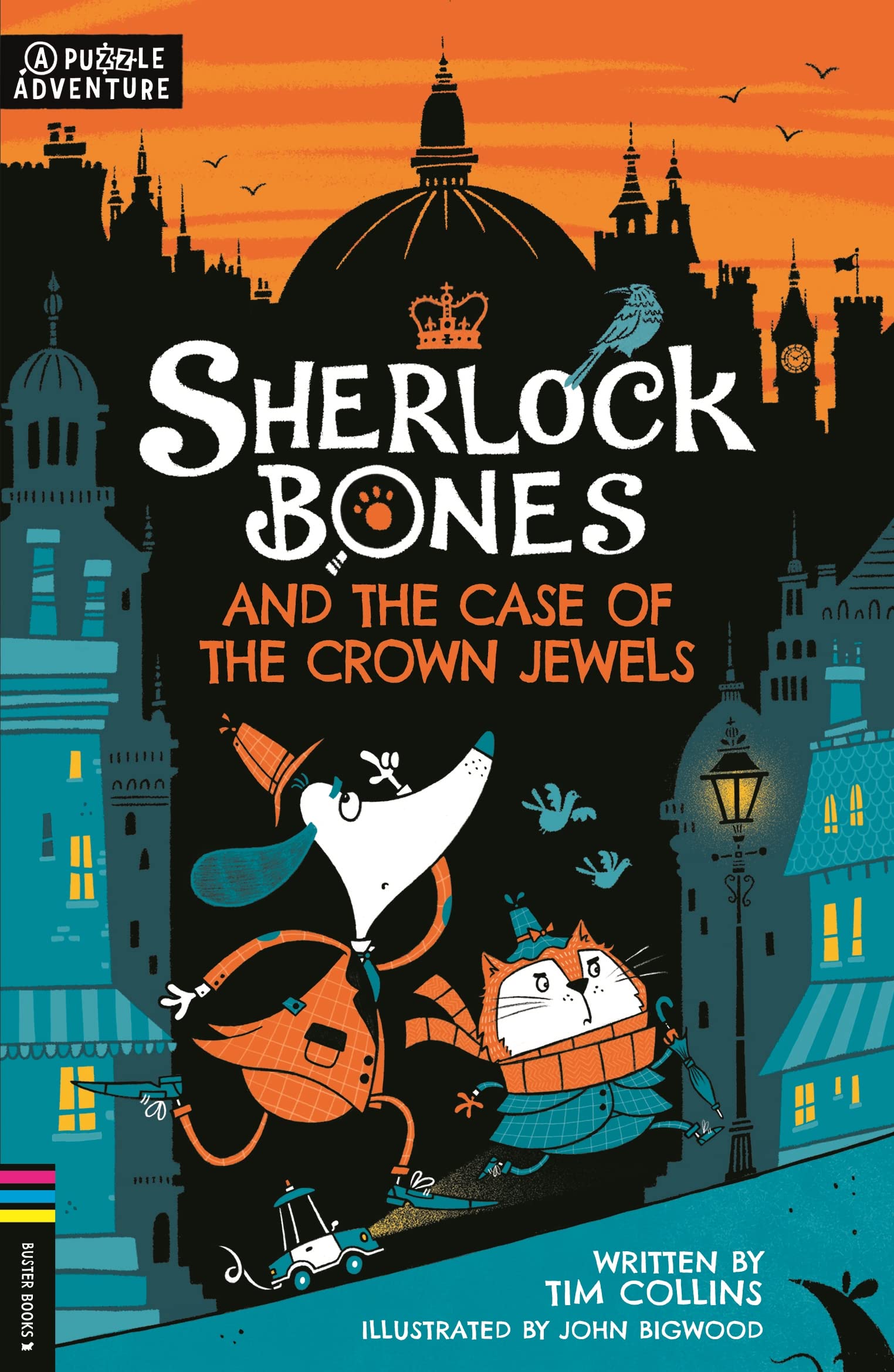
Sherlock Bones and the Case of the Crown Jewels by Tim Collins, illus. by John Bigwood (Buster Books, 192p., ages 6-9, 9781780557502, February 7, 2023)

Sherlock Bones and the Case of the Crown Jewels encourages children to join the most famous of canine detectives--accompanied by his trusty feline sidekick--in an investigation that is mysterious and exciting enough to "really puzzle over." This interactive book is the first in a series and is filled with energetic spot illustrations and a variety of games that are sure to absorb budding sleuths.

Sherlock Bones of Barker Street feels "gloomy" when things are too quiet, so his good friend Dr. Jane Catson obligingly searches through her newspaper, The Morning Terrier, for an item of interest. Catson suggests that Holmes investigate a missing shipment of Swedish carrots or an heirloom pocket watch stolen from a large Doberman. Bones wants "a crime that's worthy of the front page, not page eight." The detective is delighted when he hears a large dog approaching: Inspector Bloodhound has arrived to ask for help with something big enough for Bones to really sink his teeth into.

The Queen's crown jewels have gone missing! "The most valuable jewels in the country" were stolen overnight from Kennel Palace without any of her guards noticing. Inspector Bloodhound tells Bones and Catson that his police pups uncovered three clues that morning at the palace, but the bloodhounds "need a little help working out what they mean." First, there was the "low rumbling noise" heard by a mole over on Kitten Mews; second, "some strange markings on a tree in the park opposite the palace"; and third, "a trail of prints leading away from a puddle on the front lawn." "The world's greatest detective" leaps into action, hat on head, magnifying glass in paw and Catson hot on his heels.

Even though the police pups have turned the front lawn outside the palace into "shapeless mush," Holmes manages to spot a trail of muddy prints going down to the river, across the bridge and up the hill to posh Kennel Heights. The footprints lead to the front door of actress Molly Ruffington (of Rover and Juliet and Catbeth fame), who reports that her diamond tiara has also been stolen. Holmes thinks the tiara thief and the crown jewel thief may be "one and the same person," and he and Catson continue searching the neighborhood. Holmes finds a scrap of paper announcing yet another robbery--a beloved pocket watch taken from a Doberman named Butch. The Doberman saw the "horrible" thief, and describes a "thick black tail, large ears, and sharp, werewolf-like teeth." There have been many other burglaries in the neighborhood, too: a wedding ring stolen from the wombats in number 166, a golden racing medal taken from the greyhound in number 121 and two silver brooches thieved from the vole in number 148.

Bones and Catson head back to Barker Street to ponder their troublesome case. When the sun sets, Bones leaps into action. He grabs a bucket of water, flags down a cab and heads back to Kennel Heights with Catson. They station themselves outside Molly's home until a muddy beast with a "cruel, savage look" and long teeth "as sharp as pins" emerges. Bones and Catson apprehend the despicable thief.

But this is only the beginning. Bones and Catson, still searching for the Queen's jewels, move onto the other clues gathered by Inspector Bloodhound and the police pups: the "low rumbling noise" and the "strange markings." Homes and Catson's investigation leads them through a dark tunnel where they evade a shrieking Sewer Phantom and out to the park where they apprehend a vicious cat. But the more clues they investigate, the longer their list of suspects becomes! After many twists and turns--and plenty of puzzles for readers to solve--Bones and Catson bring their case to a satisfying conclusion.

Award-winning author Tim Collins, whose books have been published in the U.S. and abroad, uses a witty and engaging style to fashion this twisty mystery. His action-packed text provides plenty of clues to encourage readers to guess the culprit's identity. Illustrator John Bigwood, working in pencil and Photoshop, does his part by offering up intricately designed visual problems that practically beg to be solved. At first, readers are asked to rearrange letters in a word finder to figure out which story will interest Bones. Then they can "help" Bones and Catson follow the trail of prints to the river. After that, they need to arrange panels in the correct order to reveal Butch the Doberman. One fun puzzle after another peppers the text until readers follow clues to the storage chamber where the jewels are hidden, identify the villain and even figure out which of the "excitable" police bloodhound pups receives their medal first. Answers are at the back of the book, ready to be accessed immediately or pondered together at the narrative's end. All in all, Sherlock Bones and the Case of the Crown Jewels--Bones's "trickiest case yet"--should have young readers brandishing their very own magnifying glasses. --Lynn Becker, reviewer, blogger, and children's book author.

Friday, November 4, 2022

Shelf Awareness--Polar Bear

PB Review: Polar Bear


Polar Bear by Candace Fleming, illus. by Eric Rohmann (Neal Porter Books, 32p., ages 4-8, 9780823449163, November 22, 2022)

Polar Bear wisely and effectively brings climate change into focus while closely following one family of polar bears as they struggle to survive in a harsh, warming climate.

It's "April in the Arctic" and "temperatures barely nudge above freezing" when a mother polar bear and her two cubs emerge from their den beneath the snow. Mother has survived on stored fat for five months, gestating and then nursing her young, and now she's hungry and ready to hunt. Day by day, she teaches her cubs about the world outside their den, until it's time to travel "home to the ice" along a trail she used with her own mother, the same one "her cubs will take when they are grown."

The trip is long and dangerous, but the family finally arrives at "ice-covered Hudson Bay." Mother hunts while babies watch and learn. Weeks pass as the bear family gorges and gains weight, but they're in a race against time to fatten up before "summer's lean months." When the ice has melted, "seals are almost impossible to catch in open water," and this year "too much ice is melting too soon." The odds of survival are difficult in the best of times, as "only one in ten hunts succeed," and now the ice, so necessary for these bears "to hunt and eat and survive," is being depleted by warming temperatures in the Arctic.

Polar Bear is yet another wondrous collaboration from the Sibert Medal-winning team of Candace Fleming and Eric Rohmann (Honeybee). Fleming masterfully builds suspense, and her text will have readers rooting hard for this family of bears as they struggle to find food and grapple with climate change. Her lovely, lilting prose accompanies Caldecott Medalist Rohmann's breathtaking oil illustrations, which include an effective double gatefold showing the struggling bears adrift after ice melts too early. Back matter explains how polar bears have adapted to their arctic climate and brings home the need to keep climate change at bay, including a section on how readers can help.

Polar Bear, with text both informative and lyrical and achingly beautiful illustration, issues a hopeful call to action. The young bears survive two seasons of hardship and hunting with their mother and are eventually old enough to separate and "walk on, alone, beneath the Arctic sky, along familiar paths, at home on the ice." --Lynn Becker, reviewer, blogger, and children's book author.

Tuesday, October 25, 2022

Shelf Awareness--Demon in the Wood

GN Review: Demon in the Wood


Demon in the Wood by Leigh Bardugo, illus. by Dani Pendergast (Roaring Brook Press, 208p., ages 13-up, 9781250624642)

Demon in the Wood is an alluring graphic novel origin story that should invite new readers in, while deepening fans' understanding of the tyrannical Grisha leader from Leigh Bardugo's immensely popular Shadow and Bone trilogy.

The Grisha hide from the drüskelle, witchhunters who stalk the "cursed" witches across the land, from the northern "cold wilds of Fjerda" to the southern "forests and fields of Ravka." Aleksander (Eryk) and his mother, Lena, are powerful Grisha who are always on the move. They have "a hundred names, a new story for every town, camp, and city," but now they would like to spend the winter in one place, learning what they can from a Grisha chieftain. When Eryk meets witch sisters Annika and Sylvi, he impresses them with a display of his rare shadow-summoning power. Annika, whose powers are weak, convinces Eryk to help her hunt a large bear that has been sighted nearby; its bones might enhance her power. But when the new friends find the bear, it is already dead, and a potentially fatal accident on their trek home exposes Eryk's biggest secret.

Bardugo (Ninth House) depicts the antihero of her trilogy with empathy in this graphic novel rendition of a previously published short story. Eryk emerges as a complicated character, with his harsh and unavoidably solitary youth. Debut book illustrator Dani Pendergast's sophisticated illustrations allow the moody story to play out against shadowy blacks, chilly whites, grays, mauves and blues that elegantly describe a frigid, cloud-covered landscape. This is a worthy (albeit somewhat slight) addition to the canon that will surely leave readers wishing for more. --Lynn Becker, reviewer, blogger, and children's book author.

Friday, October 21, 2022

October Recommendations

Picture Books:

In RICK THE ROCK OF ROOM 214, written by Julie Falatko and illustrated by Ruth Chan, Rick sits on the Nature Finds shelf in Room 214, “with an acorn, some moss, and a piece of bark.” Rick doesn’t get to sing, jump, draw or read with the students in his classroom, he just gets to sit. But Rick begins to wish he was doing some majestic posing and jutting and tumbling like the outdoor rocks he sees in books, so he waits for his chance… Rick soon finds that the outdoors isn’t all it’s cracked up to be, and maybe there are adventures to be had back in Room 214, after all. This story has just the right blend of warm-hearted and silly. Falatko’s entertaining text is accompanied by Chan’s delightful ink and digitally colored illustrations, both of which ensure that Rick has a boulder-sized personality and plenty of charm.

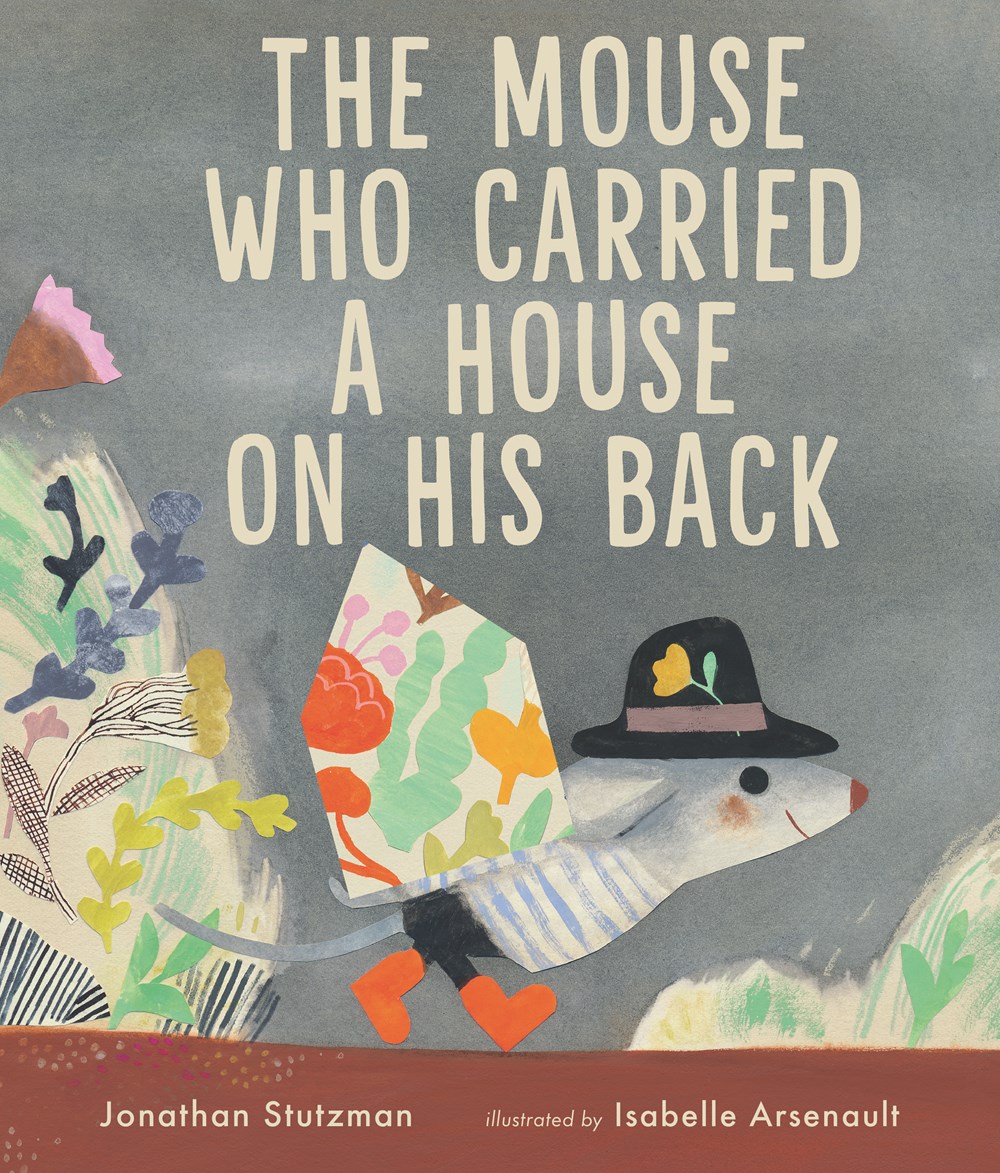
In THE MOUSE WHO CARRIED A HOUSE ON HIS BACK, written by Jonathan Stutzman, illustrated by Isabelle Arsenault, Vincent is a traveling mouse, with “boots on his feet, a hat on his head, and a house on his back.” One day, Vincent sets his house down on a hill, because that’s “where he need[s] to be.” Soon, a tired bullfrog, a cat, a family of hedgehogs, a fox, two badgers, a herd of deer, and even a bear find that Vincent’s house is “much larger than it appear[s].” This gentle, Mitten-like tale of generosity is deftly illustrated with gouache, ink, cut paper, and die-cut art, making it quite a lovely package.

IF YOUR BABYSITTER IS A BRUJA, written by Ana Siqueira, illustrated by Irena Freitas, warns readers to “be wary,” because if it’s almost Halloween, then your new babysitter “might be a bruja! A witch!” If she zooms and cackles, you’ll need to “cook up a plan!” If she if she gobbles, spits, giggles, and cackles (again), you’ll want to “flee to the magic garden!” Steal her broom if you can, but odds are you’ll end up in a “bubbling cauldron with starving ¡¡¡cocodrillos!!!” But all is not lost, so read this book to find out the rest! Colorful, cartoony digital illustrations add to the fun, beautifully showcasing the mayhem.

Like the title implies, THE SWEETEST SCOOP: BEN & JERRY’S ICE CREAM REVOLUTION, written by Lisa Robinson and illustrated by Stacy Innerst, is the story of Ben Cohen and Jerry Greenfield, and how they founded their great ice cream empire. Apparently, these “two groovy guys” met when they were twelve. One liked art and one liked science, but they both loved food. They figured out how to make ice cream, how to sell ice cream, “how make their flavors stand out,” and they figured out how to “use ice cream to make the world a better place. Chunky Monkey, Wavy Gravy, Cherry Garcia. Save our Swirled, Empower Mint, Imagine Swirled Peas. Yum! A super-engaging text is peppered with riddles and accompanied by playful watercolor, ink, and Photoshop illustrations. This book’s a treat!

AMERICAN DESI, written by Jyoti Rajan Gopal and illustrated by Supriya Kelkar, portrays a young girl’s earnest look at what it means to belong to two cultures. Is she “Bollywood moves” or “hip-hop grooves?” Is she “cricket wickets… and screams for all” or “football scrimmage, sacks, and calls?” Using colors to define the different strands that pull and tug at her heart, this affirming picture book written in rhyme assures readers that our main character has “no need to hide/The many colors of me.” The paper, fabric, mixed media, and digitally collaged illustrations are bright, full of energy, and work in perfect harmony with the text.

LOOK, by Fiona Woodcock, is an intriguing concept book that restricts itself to only words spelled with two Os in a row. As sun rises, it’s time for “FOOD” then “BOOTS,” after which a sister and brother “ZOOM” to the “ZOO.” They see a kangaroo, and a cockatoo, and a panda eating bamboo, and you get the idea. Finally, things wind down at bedtime with a shampoo and a book, while outside there’s some more double-o magic to end this most interesting of days. Hand-cut rubber stamps, stencils, pen and pencil art, all composited digitally, bring to life this clever idea with a text that seems to achieve its goal effortlessly.

--Lynn

Wednesday, October 12, 2022

Shelf Awareness--Curve and Flow

PB Review: Curve and Flow


Curve and Flow: The Elegant Vision of L.A. Architect Paul R. Williams by Andrea J. Loney, illus. by Keith Mallett (Knopf Books for Young Readers, 48p., ages 4-8, 9780593429075)

Curve and Flow tells the inspiring story of Paul R. Williams, a gifted architect who worked hard to achieve success despite early 20th-century racism in the U.S.

Los Angeles-born Paul "loves to draw and draw--especially buildings!" As a boy who dreams of designing his own home someday, he delights in the "swooping lines of L.A. [that] curve and flow around him." Unfortunately, the "big stone wall of racism" blocks his path. But Paul "loves a challenge," and even though no one has "ever heard of a Negro architect," he's determined to "take a curve and flow around" the problem. He studies, hones his skills and wins contest after contest with his clean and clever designs. He's hired by a top architectural firm in L.A., then starts his own business. Paul designs "bold, dazzling, innovative, and unforgettable" homes--houses he's not allowed to live in because "a huge invisible wall of laws... blocks Black people from living in many parts of Los Angeles." But he never stops believing he'll design his own home, never stops working, planning, building, curving and flowing until he makes his dream come true.

Andrea J. Loney's (Double Bass Blues) lyrical approach and recurring metaphors allow her to relate Williams's story deftly and with a gentle hand. Her back matter contains an extensive timeline that grounds and expands her focused text. Keith Mallett's (Sing a Song) detailed digital illustrations--including stunning endpapers--give a strong sense of the era; blues, browns and yellows lend an appropriately old-timey feel. Curve and Flow delivers an accomplished and uplifting biography of a Black man who "created more than 3,000 structures around the world" and is integral to the history of Los Angeles. --Lynn Becker, reviewer, blogger and children's book author.

Thursday, October 6, 2022

October's Book of the Month--The Ogress and the Orphans

October’s Book of the Month is Kelly Barnhill’s THE OGRESS AND THE ORPHANS, a masterful middle grade fantasy by a masterful storyteller.

Stone-in-the-Glen “used to be a lovely town. Everyone said so.” It was full of all kinds of trees, and friendly, helpful neighbors. At its heart was the Library. But after the library burned down and then the school, after the trees died and the light became a “constant, searing whiteness,” the good people of Stone-in-the-Glen squinted angrily at each other and retreated inside their homes.

This suits the Mayor just fine.” With his “blinding shock of blond hair,” the Mayor, who “glitter[s] when he [speaks],” had once been a “World-Famous Dragon Hunter,” but now he simply lives in the Mayor’s mansion and dazzles the people of the town.

By the time the Ogress arrives, the town is a wretched place. No one helps anyone else, and the orphans—all fifteen of them—as well as Matron and her husband Myron, really do need some help. The Ogress decides to deliver gifts to everyone in the sad little town, excess bounty from her garden baked into sweet treats, lovingly placed on doorsteps by herself, the crows, and Dog. No one knows who brings these gifts, and the townspeople are all too miserable to care. But when a child from the orphanage goes missing, the Mayor is quick to stir up plenty of anger, and point the increasingly angry mob in the direction of the one villager who appears to be most different—the Ogress.

This is one of Barnhill’s best. Ogres, dragons, orphans, and books, all lovingly spun into a truly delightful and thought-provoking read. Like the Ogress’s treats, there should be plenty for young readers to chew on here.

--Lynn